Stop 6 of 8Basque Country, Spain · A village fiesta in the Basque Country
Basque stone lifting: one stone, two brothers, no shoulders
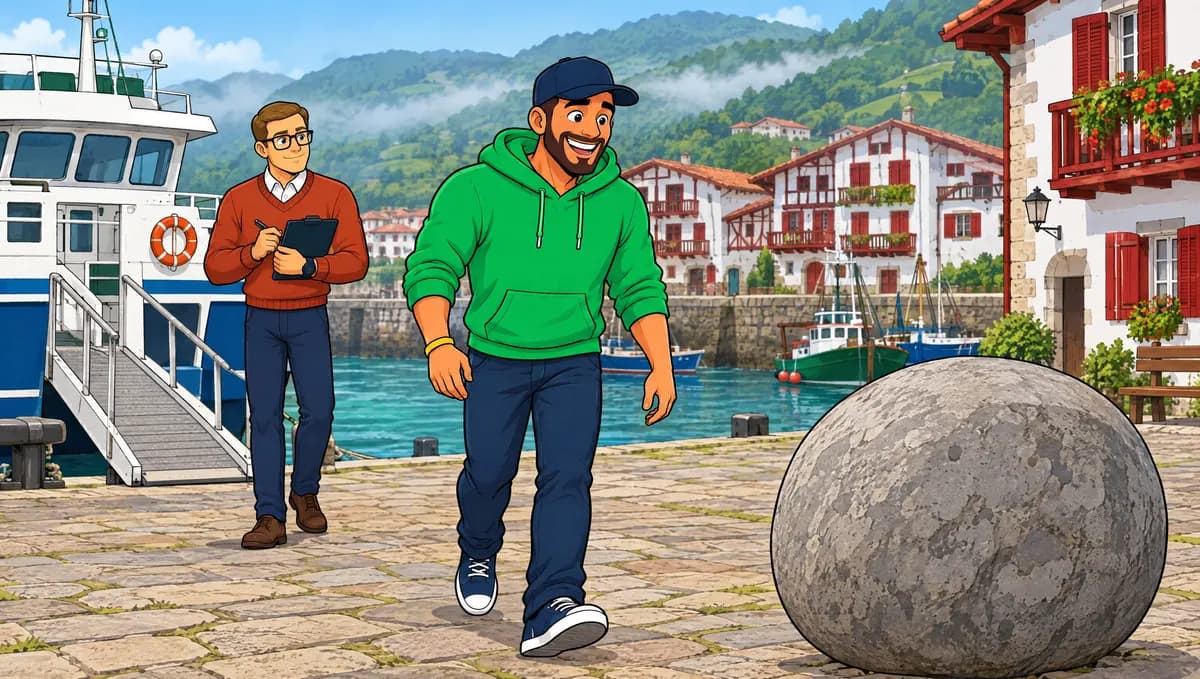
Stop six, the Basque Country. Beni brought a notebook full of weights. Beto brought a lot of confidence and his green hoodie. The stone did not care about either.
What is Basque stone lifting?
Harri-jasotzea, Basque stone lifting, is one of the herri kirolak, the rural sports of the Basque Country. It grew out of everyday work on Basque farms and in quarries, where people moved heavy stones by hand.
What are the rules of stone lifting?
The lifter raises the stone from the ground onto the shoulder, a judge accepts the lift, and the stone is dropped onto a mat. Some contests are a single lift of the heaviest stone; in others, lifters raise the same stone as many times as they can in the time allowed.
What shapes are the stones?
The rough rocks of the past became four shapes: the cylinder, the cube, the sphere and the rectangle. Each one needs its own technique, and lifters say technique matters as much as strength.
How old is Basque stone lifting?
It is thought to be very old, but there are no old written records, so it is often called the oldest sport with the shortest history. It came to public squares as a sporting challenge in the early 20th century.
Where can you see stone lifting?
In summer, at the big Basque town festivals, such as Aste Nagusia in Bilbao, where the lifters perform in the Plaza del Arriaga, or the Virgen Blanca festival in Vitoria-Gasteiz. Women now take part too, and have their own championships.
What is the Basque stone lifting record?
The record for lifting a 150-kilogram stone on and off the shoulder in 10 minutes is 52 lifts.
Beni researched it
Harri-jasotzea is stone lifting, the most famous of the herri kirolak, the Basque rural sports. The lifter gets the stone onto one shoulder; that is the whole lift, and it takes a great deal of strength.
Competition stones range from 100 to 326 kilograms. Some contests are a single lift of the heaviest stone; in others the lifter puts a 150-kilogram stone on the shoulder and off again as many times as possible in ten minutes.
At a village fiesta, an instructor let Beto try the smallest training stone, with a straight back, a helper on each side and a good deal of chalk. My note before the lift said: knees. I did not show it to him until afterwards. Then I tried the same stone myself, and it did not leave the ground. I wrote that down as well.
Beto tried it
It's a rock. I've lifted rocks. How hard can a rock be.
Very. It's very hard. That's what rocks are. Got it to my knees, and me and the rock had a long talk about going higher. The rock said no.
The instructor said good start. Then Beni showed me his note. Knees. Then he had a go himself and the rock didn't even move for him. So I'm the strong one. Write that down.
On it Carrying the shopping up to Beni's flat for a week, on whether Beto would get the stone to his shoulder. It stopped at his knees. Beto carried the shopping, one bag at a time, and called every bag a stone. Beto paid.

Beni’s sources
- Harri-jasotzea, the Basque stone lift: the most famous of the herri kirolak, the stone lifted onto the shoulder, competition stones from 100 to 326 kg, single lifts of the heaviest stone, and the ten-minute contest of lifting a 150 kg stone on and off the shoulder, from EuskoGuide's page on Basque rural sports.
- The answers above, from: Basque Country Tourism (Euskadi Turismo): Basque sport, stone lifting · Onda Vasca: 17º campeonato de Levantamiento de la Piedra de Etxauri · Basque Government, Department of Culture: Deporte autóctono, harrijasotzaile · Buber's Basque Page: Basque Fact of the Week: Basque Stone Lifters · EuskoGuide: Herri Kirolak, Basque rural sports · Planomato: Aste Nagusia 2026: la cultura vasca en el centro · Smithsonian Folklife Festival: Basque Sports
The facts are Beni’s, from the sources above. Beto’s try is the brothers’ own story: Beni & Beto are fictional characters.